Research
Diagnosing the Limitations of Artificial Working Memory
A near perfect working memory model, stressed three ways until it broke.
URECAMerit2025/26
100%
Clean baseline accuracy
Change detection, delayed trials only
50.3%
Under retention interference
Random static. Chance, with a 0.97 Changed rate
93.6%
Object vs background recolour
93.6% object against 50.3% background
445
Trials per condition
Across 5 change detection variants, fixed seed
Recurrent working memory models score perfectly on clean benchmark trials, and that number says nothing about how they fail. I took a pretrained LSTM-96 from the WorM benchmark (NeurIPS 2023), froze it, and went looking for the break.
The task
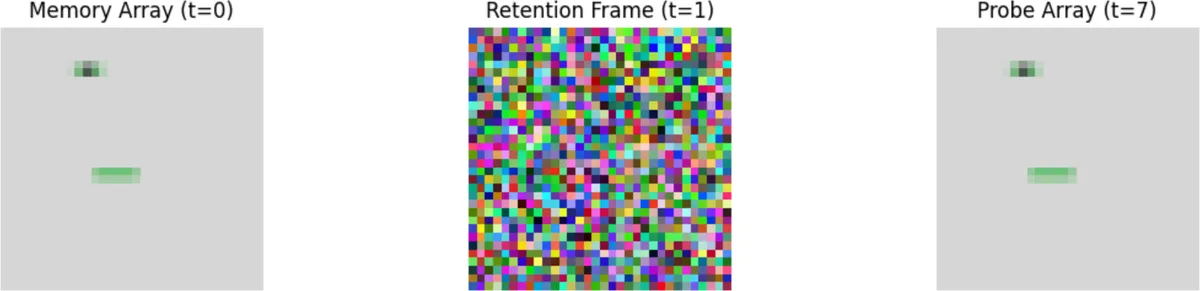
Five change detection variants, 445 delayed trials per condition, a fixed seed, and every manipulation label preserving by construction.
1. Noise in the delay
Stage 1, accuracy by what fills the delay
Hover a bar for the Changed rate. Chance is 0.5.
Only the delay frames change. Every pattern drives accuracy to chance, and the model answers Changed 93 to 97% of the time. The memory is being overwritten while it is held.
2. Objects against background
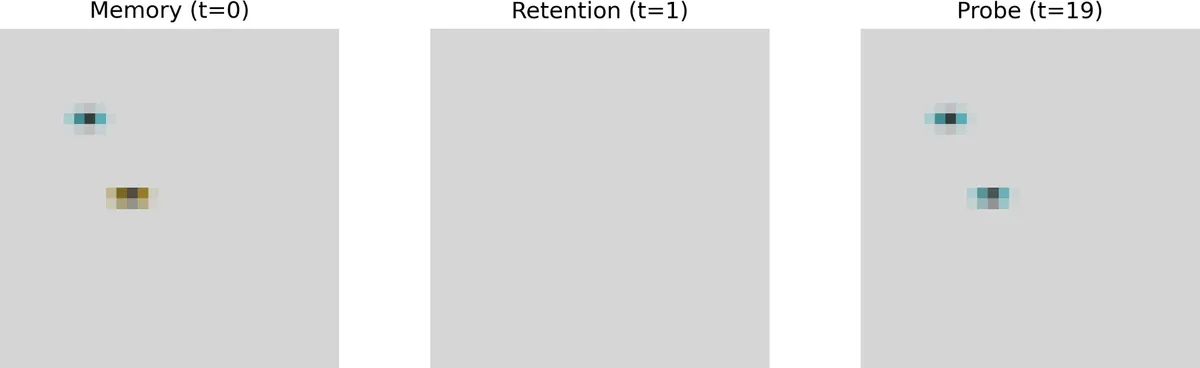
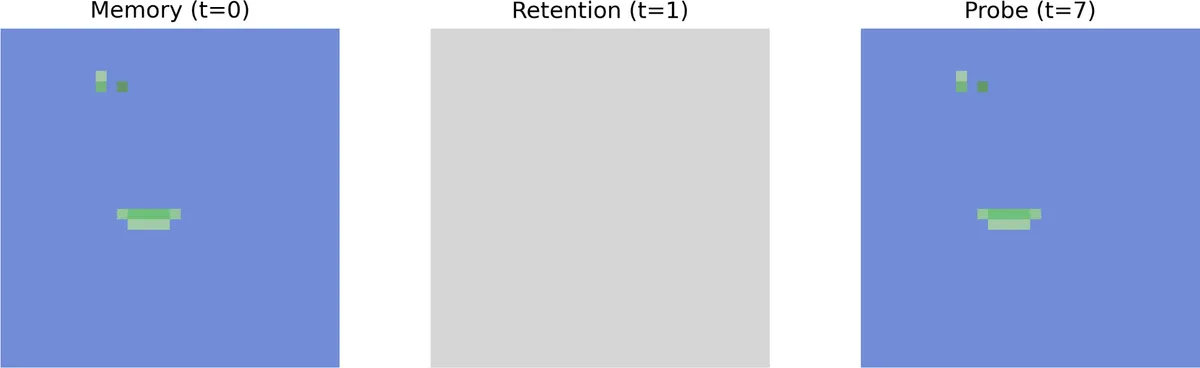
Stage 2, accuracy by change detection variant
- Clean grey
- Object recolour
- Background recolour
Hover a column for its exact accuracy. Chance is 0.5 on these balanced trial sets.
Robustness here tracks how much of the image moved, not whether the change mattered to the task.
3. A dose response
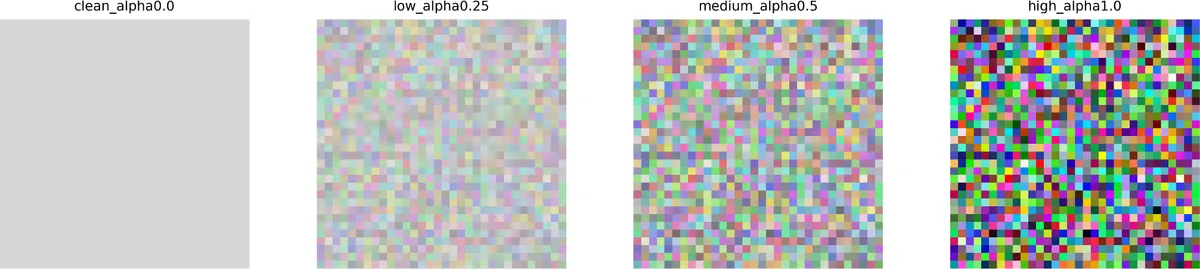
Stage 3, accuracy against distractor contrast
contrast 0.25 accuracy 0.693 answers Changed 62% of the time
Only the six measured contrasts. Full contrast reproduces the Stage 1 random static result.
Low contrast leaves the model intact. By 0.5 it is at chance. Saliency breaks it, not the mere presence of a pattern.
What it means
- Maintenance across the delay is fragile, and the fragility is graded.
- The encoder leans on the background: the shortcut learning story again.
- Report decision bias beside accuracy. The pair separates corrupted maintenance from corrupted encoding; accuracy alone cannot.
Limits
One model, zero shot, behavioural only. 445 trials per condition is enough for the large effects here and no smaller ones.
Credits
Supervised by Asst Prof Zhang Mengmi, College of Computing and Data Science, NTU, under the URECA programme. Model and stimuli from WorM: Sikarwar and Zhang, “Decoding the Enigma”, NeurIPS 2023 Datasets and Benchmarks.